The simplest way to tell them apart: if the car starts after a jump and then keeps running, the battery is the likely problem. If it starts after a jump but dies again while you’re driving, or the battery warning light comes on while driving, the alternator is the likely problem. The battery starts the car; the alternator keeps it running and recharges the battery.
The two fail in similar ways, and a bad alternator can kill a good battery, so it pays to test both. Here’s what each one does, the signs that point to each, and a quick test with a cheap voltmeter.
The quick way to tell
| Symptom | Points to |
|---|---|
| Slow crank or clicking in the morning, fine once running | Battery |
| Starts with a jump, runs fine, dead again next morning | Battery, or something draining it overnight |
| Starts with a jump, dies while driving | Alternator |
| Battery or charging warning light on while driving | Alternator or its belt |
| Headlights dim at idle and brighten when you rev | Alternator |
| Whining or growling noise from the front of the engine | Alternator bearing |
| Burning rubber or electrical smell | Alternator belt slipping or alternator overheating |
| New battery dies within weeks | Alternator not charging, or a parasitic drain |
Signs it’s the battery
- The engine cranks slowly, especially on the first start of the day
- Rapid clicking when you turn the key, like we describe in Car Won’t Start, Just Clicking?
- The battery is more than three years old, which is old for a Texas battery
- Swelling of the case, corrosion on the terminals or a rotten-egg smell near the battery
- Electronics resetting or acting up on start-up, such as the radio or clock
Signs it’s the alternator
- The battery light or a “charging system” message comes on while driving
- Lights dim and brighten with engine speed, or flicker
- Power windows, the blower motor or the radio get weak and slow
- The car stalls or dies while driving, often after the lights dim
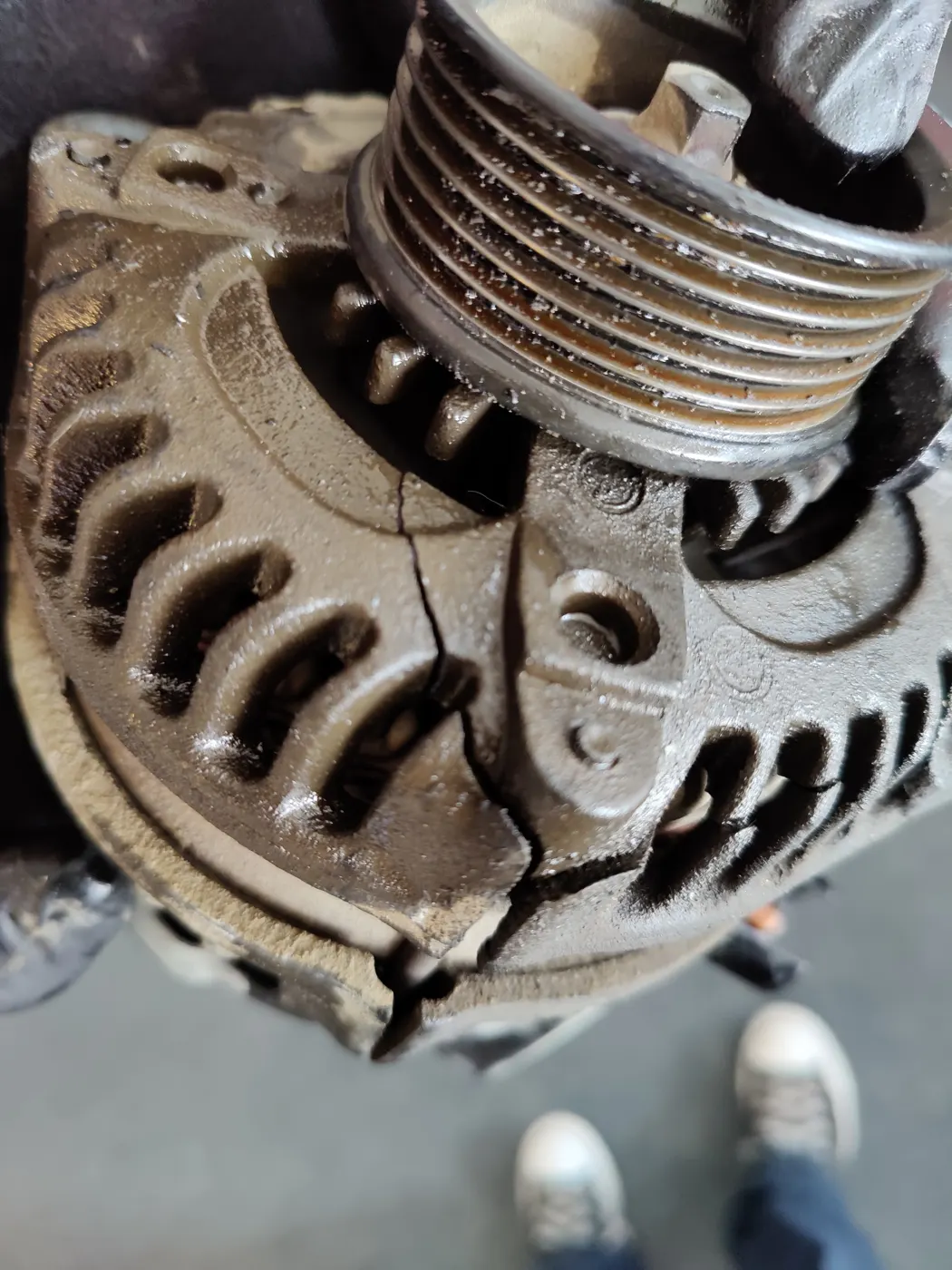
- A whine that rises with engine speed, or a growl from a worn bearing
- A belt squeal, especially when you turn on the A/C or headlights
A simple voltmeter test
A basic digital voltmeter from any hardware store tells you a lot:
- Engine off, car sat for an hour: a healthy, fully charged battery reads about 12.6 volts. Around 12.2 volts means it’s about half charged. Below 12 volts, it’s flat or failing.
- Engine running: most cars should read about 13.8 to 14.5 volts at the battery. That’s the alternator charging.
- Engine running with lights, blower and rear defrost on: the reading should stay above about 13.5 volts.
If the running voltage stays near 12 volts or keeps dropping, the alternator isn’t charging. If it’s well over 15 volts, the voltage regulator may be overcharging, which can boil a battery.
Some newer cars, including many European models, use “smart” charging that varies the voltage on purpose to save fuel. Their readings can look odd on a simple meter, which is one reason a proper charging system test is worth it.
A voltmeter doesn’t tell you how much capacity a battery has left. A battery can show 12.6 volts and still fail under load. That takes a load test or a conductance tester.
Why European cars need the battery registered
On many BMWs, Audis, Volkswagens and other European cars, the charging system adjusts how it charges based on the battery’s age and type. When a new battery goes in, the car needs to be told, which is called battery registration or coding. If it isn’t, the car keeps charging the new battery as if it were the old, worn one. That can overcharge it and shorten its life, and it can cause odd electrical faults.
The battery type matters too. Many European cars use AGM batteries, and swapping in a standard flooded battery causes charging problems. We register and code batteries as part of the job on European cars.
Get both tested in one visit
Because a weak alternator can ruin a new battery, and a bad battery can overwork an alternator, we test both at the same time. We check the battery’s health under load, the alternator’s output at idle and under load, the belt, and the main cables and grounds. If the battery keeps dying overnight, we check for parasitic draw, something staying on after the car is locked.
Then we tell you which part is bad, and whether the other one is fine.
Awesome shop. Had an alternator poop out and these guys were able to get me in on short notice and get me back on the road.
Chris Adams, Google review
See our alternator repair, battery testing and replacement and electrical repair pages for more.
Frequently asked questions
Can a bad alternator ruin a new battery?
Yes. An alternator that undercharges leaves the battery partly flat, which shortens its life. One that overcharges can boil it.
Will a car run with a bad alternator?
For a short time, on battery power alone. Once the battery runs down, the car will stall, often after the lights and gauges start acting up.
How long do car batteries last in Texas?
Heat shortens battery life. In hot southern climates, three years or so is common, compared with longer in cooler places.
Do I need to register a new battery on my BMW or Audi?
On many models, yes. Registration tells the car a new battery is installed so it charges it correctly.
Bring it to Figure Automotive in Huntsville
We test the battery and the charging system together, so you don’t replace a good battery when the alternator is the real problem, or the other way around.
Call (936) 439-4346 or request a Free Written Estimate. We are at the shop Monday through Friday.