Most BMW coolant leaks come from four places: the water pump, the plastic expansion tank, the hose fittings and the thermostat housing. BMW uses a lot of plastic in its cooling systems, and after years of heat cycles those parts crack, warp or let go. Many newer BMWs also use an electric water pump that can quit with little warning.
A coolant leak is not one to drive around with. BMW engines use aluminum blocks and heads, and overheating one even once can warp the head or blow the head gasket. Here’s what fails, how to spot it early, and what to do if the temperature warning comes on.
Where BMWs leak coolant
Expansion tank and bleeder screw
The expansion tank is the plastic reservoir where you check the coolant. On many BMWs it holds pressure and carries the radiator hoses. The plastic gets brittle, seams crack, and the small plastic bleeder screw breaks. A leak here often shows up as dried coolant crust on the tank or a sweet smell after driving.
Water pump
BMW has used both belt-driven and electric water pumps. Belt-driven pumps leak from the shaft seal and weep coolant down the front of the engine. Electric pumps, used on engines like the N52, N54, N55 and N20, can stop working without leaking at all. When an electric pump fails, the coolant stops moving and the engine overheats quickly.
Hoses and plastic fittings
BMW hoses often end in plastic quick-connect fittings. The hose rubber holds up longer than the plastic, so it’s common for a fitting to crack or a clip to break. The upper radiator hose and the small hoses to the heater core and expansion tank are frequent offenders.
Thermostat housing and radiator
The thermostat housing is often plastic too, and the radiator’s plastic end tanks can crack along the seam. A radiator leak usually leaves crust along the edge of the tank.
The electric water pump problem
Because an electric water pump doesn’t always leak before it fails, the first sign can be a warning on the dash. BMW’s electric pumps run on their own module and can fail electrically or mechanically. Some cars give a warning a few weeks ahead, such as the fan running loudly or the pump being noisy after shutdown. Others just stop.
If your BMW has an electric pump and is past about 70,000 miles, it’s worth having it checked as part of regular service, especially before summer.
Warning signs to watch for
- Low coolant warning on the dash, even once
- Sweet smell after driving, or steam from under the hood
- Pink, blue or green crust around the tank, hoses or front of the engine
- Puddles under the front of the car
- Temperature warning or the fans running hard after a short drive
- Heater blowing cold in winter, which can mean low coolant
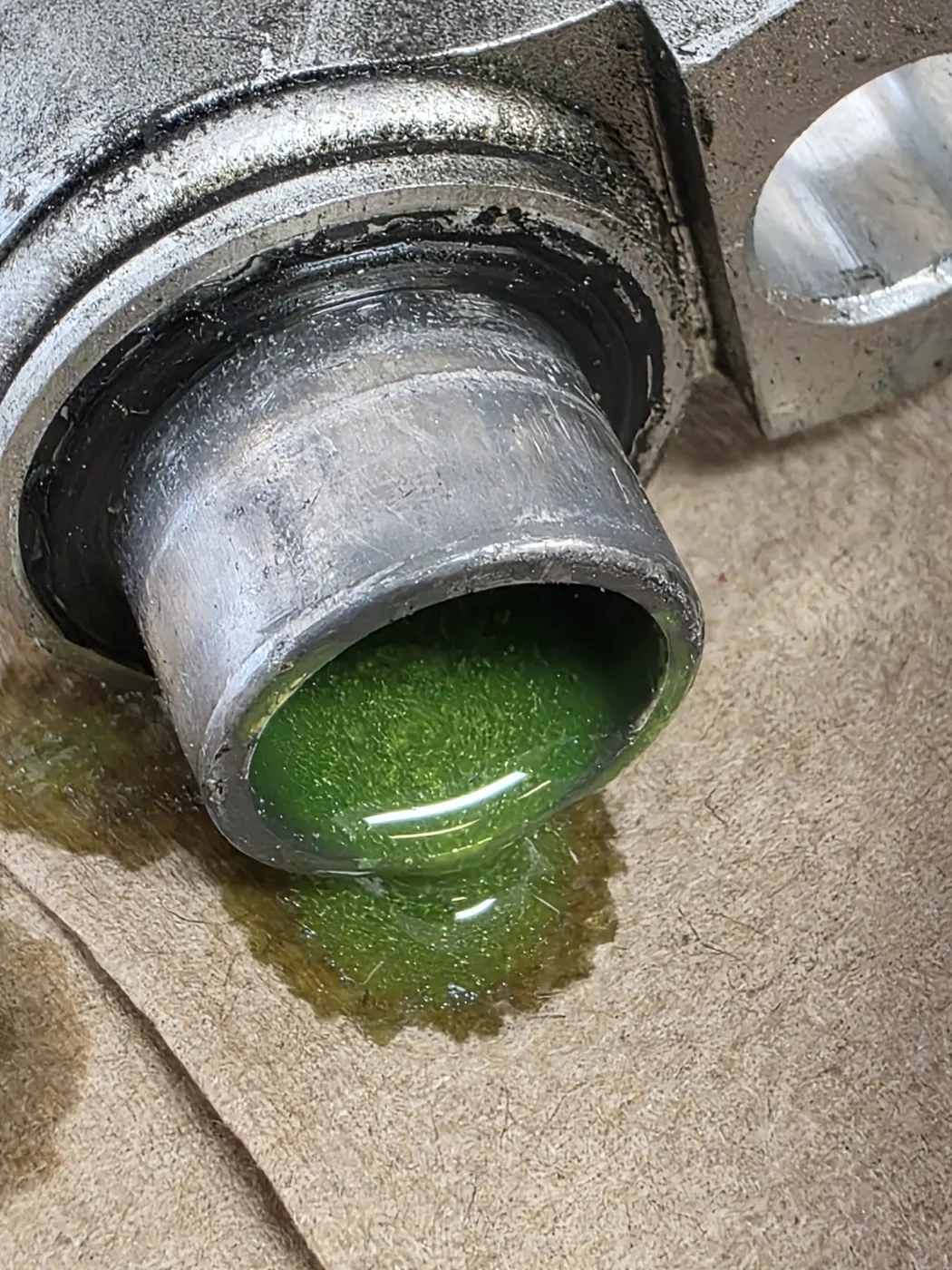
BMW coolant is usually blue or green, and the color shows up well on concrete. If you’re topping off coolant more than once in a while, there’s a leak somewhere.
Why you should never drive a hot BMW home
If the temperature warning comes on, pull over and turn the engine off as soon as it’s safe. It’s tempting to keep going to get home, but BMW engines don’t tolerate overheating. The aluminum cylinder head can warp, the head gasket can fail, and the plastic cooling parts can split under the extra pressure. A tow is a lot cheaper than a head gasket repair.
Don’t open the expansion tank cap while the engine is hot. The system is pressurized and the coolant can spray out.
Doing the cooling system as a set
When one plastic cooling part fails on a BMW with high miles, the others are usually the same age and close behind. It often makes sense to replace the water pump, thermostat, expansion tank and key hoses together, especially on a car you plan to keep. You do the job once, you bleed the system once, and you’re set for years.
We pressure test the system first to find exactly where the leak is, and we’ll tell you which parts look fine and which are on borrowed time. Bleeding a BMW cooling system properly matters too: air left in the system can cause overheating even after the leak is fixed.
Huntsville heat and stop-and-go traffic on I-45 put a lot of stress on a cooling system. If you’ve seen any of the signs above, get it checked before the hot months. If you also have oil around the front of the engine, read our post on BMW oil leaks, because an oil filter housing gasket can leak into the cooling system on some engines.
See our BMW repair and radiator and cooling system repair pages for more.
Frequently asked questions
Can I drive my BMW with a coolant leak?
Only for short distances while watching the temperature, and only if the leak is slow. If the low coolant or temperature warning comes on, stop driving.
How do I know if my BMW water pump is failing?
Coolant weeping from the front of the engine, a warning on the dash, the fans running loudly, or overheating. Electric pumps can fail without any leak.
What color is BMW coolant?
BMW coolant is usually blue or green. Use a coolant that meets BMW’s specification rather than a generic universal coolant.
Why do BMW expansion tanks crack?
They are plastic and hold pressurized hot coolant. After years of heat cycles, the plastic becomes brittle and seams crack.
Bring it to Figure Automotive in Huntsville
A low-coolant warning on a BMW is worth taking seriously, especially heading into a Texas summer. We’ll pressure test the system, find the leak and show you what we find.
Call (936) 439-4346 or request a Free Written Estimate. We are at the shop Monday through Friday.