Jeep death wobble is a violent shaking of the front end and steering wheel, usually set off by a bump at 45 to 55 mph, that only stops when you slow way down. It happens on solid front axle Jeeps like the Wrangler and Gladiator, and it’s almost always caused by a worn or loose steering or suspension part, most often the track bar.
It feels terrifying the first time, and it’s dangerous, because you lose a lot of steering control while it’s happening. The good news is that it’s a mechanical problem with a mechanical fix. Here’s what causes it and how we track it down.
What death wobble actually is
A solid front axle is tough and simple, which is why Jeeps use it. The downside is that both front wheels are tied together. If one part of the steering or suspension has play in it, a bump can start the axle oscillating side to side. Each swing feeds the next one, and within a second the whole front end is shaking.
It’s not a balance problem or a “Jeep thing” you have to live with. Something in the front end is loose, and it’s letting the axle move when it shouldn’t.
The parts that cause it, in the order we check them
1. Track bar and track bar bolts
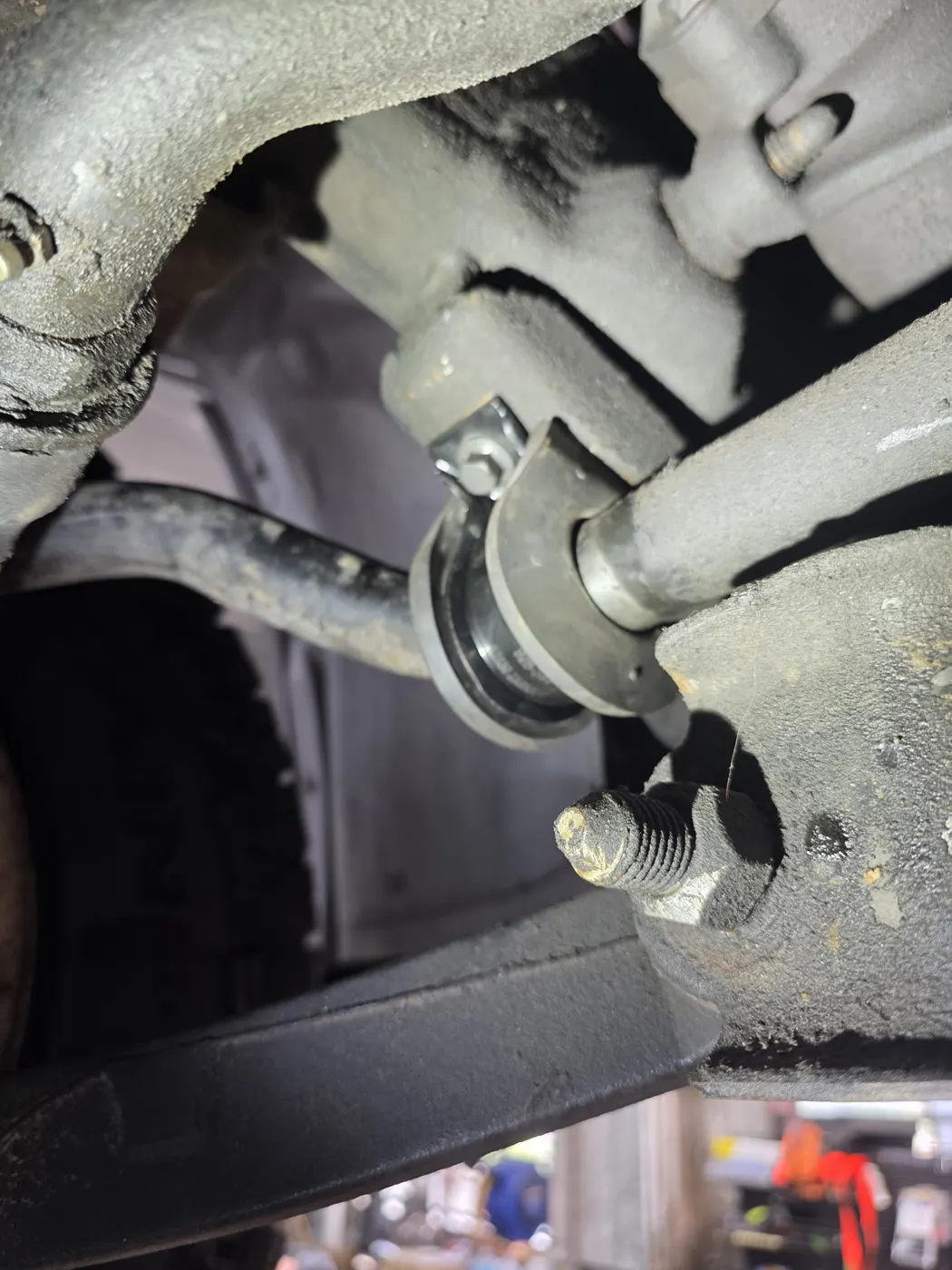
The track bar keeps the axle centered under the Jeep. Its bushings wear, its ball joint (on newer models) gets sloppy, and its mounting bolts can work loose or wallow out the holes in the bracket. This is the single most common cause of death wobble. Even a slightly loose track bar bolt can start it.
2. Tie rod ends and drag link
These connect the steering box to the wheels. Worn ends let the wheels move independently of the steering wheel, which is exactly what death wobble needs.
3. Ball joints
Worn upper and lower ball joints let the knuckles rock on the axle. On a heavier Jeep with bigger tires, ball joints wear faster.
4. Control arm bushings
Worn bushings let the axle shift fore and aft, which changes the steering geometry over bumps.
5. Wheel bearings and hubs
A loose unit bearing lets the wheel wobble on the hub.
6. Tires and wheels
Out-of-round or badly balanced tires don’t usually cause death wobble on their own, but they can set it off when other parts are worn. If we find a tire problem, we’ll tell you so your tire shop can take care of it.
How we find the worn part
The best test is simple. With the Jeep on the ground and the engine running, one person rocks the steering wheel back and forth while another watches every joint from underneath. Any part that moves before the next part moves is the loose one. Track bar ends, tie rod ends and the drag link show up quickly this way.
Then we lift the front end and check the ball joints, bearings and bushings for play, and we check every bolt in the front end for torque. It’s common to find two or three worn parts, not just one.
Why a new steering stabilizer isn’t a fix
A lot of people are told to put on a bigger steering stabilizer. A stabilizer is a shock absorber for the steering. It can damp the wobble enough to hide it, but it doesn’t fix the loose part causing it, and the worn part keeps wearing. When the stabilizer wears out, the wobble comes back, often worse.
Replace a stabilizer if it’s leaking or worn. Just don’t count on it to cure death wobble.
Lifted Jeeps and bigger tires
Lift kits change the angles of the track bar, control arms and steering, and bigger, heavier tires add a lot of leverage against every joint. That’s why lifted Jeeps get death wobble more often. If the track bar wasn’t corrected for the lift, the axle can sit off-center, and if the caster angle is off, the steering doesn’t self-center well.
On a lifted Jeep, the fix sometimes includes an adjustable track bar, a relocation bracket or correcting caster, along with replacing worn parts.
What the repair involves
Every death wobble repair is different because it depends on which parts are worn. A typical repair includes:
- Replacing the worn track bar, tie rod ends, drag link or ball joints
- Torquing every front-end bolt to spec
- Checking and replacing the steering stabilizer if it’s worn
- A test drive over the kind of bump that set it off
After front-end parts are replaced, the Jeep needs an alignment. Alignments aren’t done in our shop, so we send the Jeep to an alignment partner as part of the job, and the test drive happens after that.
This kind of work suits the roads around here. Rutted county roads, washboard gravel and the forest roads in the Sam Houston National Forest wear Jeep front ends quickly. See our Jeep repair, struts and shocks and truck repair pages for more.
Best auto shop in town. They did an amazing job on my suspension, tie rods, control arms. My car drives sooo smooth. They are extremely knowledgeable and will give you the best price. Highly recommend!
Victoria Gallon, Google review
Frequently asked questions
What should I do when death wobble starts?
Grip the steering wheel firmly, don’t slam on the brakes, and slow down gradually. The shaking stops as you lose speed. Then have the front end checked before driving at highway speed again.
What is the most common cause of Jeep death wobble?
A worn or loose track bar, its bushings or its mounting bolts. Tie rod ends, the drag link and ball joints are next.
Will a steering stabilizer fix death wobble?
No. It can hide the shaking, but it doesn’t fix the loose part causing it. The wobble usually returns.
Do I need an alignment after fixing death wobble?
Yes. After steering and suspension parts are replaced, the front end needs an alignment. We send the Jeep to an alignment partner as part of the repair.
Bring it to Figure Automotive in Huntsville
Death wobble always has a worn or loose part behind it. Bring your Jeep in and we’ll find it, show you, and give you a Free Written Estimate before we replace anything.
Call (936) 439-4346 or request a Free Written Estimate. We are at the shop Monday through Friday.