Audi timing chain problems depend on the engine. The best-known one is the timing chain tensioner on 2008 to 2012 era 2.0T engines, used in the A4, A5, Q5, TT and many Volkswagens, which can fail and let the chain jump teeth. The 3.0T V6 and 4.2 V8 have chains mounted at the back of the engine, so their chain work is a much larger job.
All of these are interference engines, which means a chain that jumps or breaks lets the valves hit the pistons. Here’s how to tell if your Audi is at risk and what the warning signs sound like.
Which Audi engines have chain problems
| Engine | Found in | Known issue |
|---|---|---|
| 2.0T (EA888, early versions) | A3, A4, A5, Q5, TT, and VW GTI, Jetta, CC, Tiguan | Timing chain tensioner can fail, chain can jump |
| 2.0T (later versions) | A3, A4, A5, Q3, Q5 and others | Fewer tensioner failures; chain stretch at higher miles |
| 3.0T supercharged V6 | A6, A7, A8, Q5, Q7, S4, S5 | Chains and guides at the rear of the engine wear with age |
| 4.2 V8 | A6, A8, Q7, S5, R8 and others | Chain guides wear, chains at the rear of the engine |
The 2.0T tensioner you should know about
On early versions of the EA888 2.0T, the hydraulic timing chain tensioner was prone to failing. When it lets go, the chain loses tension and can skip teeth on the sprockets, usually at start-up. Audi and Volkswagen revised the tensioner part during production, and many cars have had the updated one fitted since.
If you own an Audi or VW with a 2.0T from roughly 2008 to 2012, it’s worth knowing which tensioner is in your engine. If there’s no record of it being replaced, it’s worth a check. Replacing the tensioner, and often the chain and guides, before it fails is far cheaper than repairing bent valves.
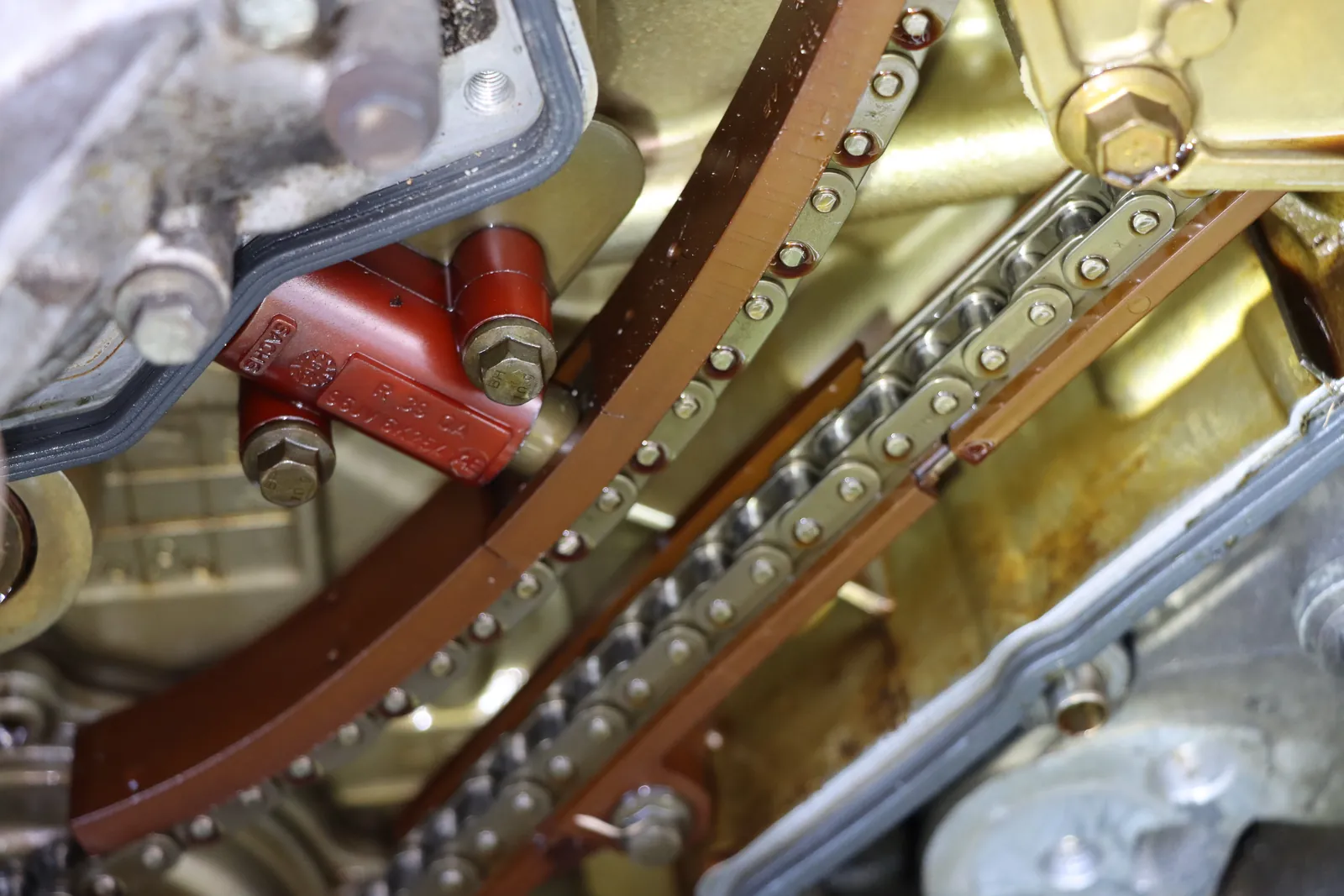
Rear-mounted chains on the 3.0T and 4.2
On the 3.0T supercharged V6 and the 4.2 V8, Audi put the timing chains on the transmission side of the engine. That packaging saves space, but it means the engine or transmission has to come out to reach them. Guides wear and chains stretch with mileage, and the plastic guides can become brittle with age and heat.
Because the job is so big, we usually recommend replacing every chain, guide and tensioner while it’s apart, along with seals and other wear parts that are easy to reach with the engine out.
Symptoms and codes
- Rattle on a cold start lasting a few seconds, often from the front of the engine on the 2.0T or the back on the V6 and V8
- Check engine light with camshaft and crankshaft correlation codes such as P0016, P0017, P0011 or P0341
- Rough running or misfires if the timing has moved
- Engine won’t start after a rattle, which can mean the chain has jumped
Audi engines also report how far the camshaft timing has drifted in live data. Reading those values tells us whether a chain is stretching, even before it rattles.
Preventive replacement vs. waiting
With interference engines, the gamble is simple. If the chain jumps far enough, valves hit pistons and the repair becomes an engine rebuild or replacement. If it’s caught early, it’s a timing job.
We recommend checking timing data on any high-mileage Audi, and replacing the tensioner and chain on an early 2.0T with no record of the update. If your Audi is also burning oil, has a check engine light or rattles at start-up, read our post on what to do when the check engine light flashes and get it looked at sooner.
Keeping the oil fresh helps too. Tensioners are hydraulic and depend on clean oil, which is one reason we suggest shorter synthetic oil intervals in Texas heat.
See our Audi repair, Volkswagen repair and engine repair pages for more.
Frequently asked questions
How do I know if my Audi timing chain is bad?
A rattle on cold start, a check engine light with camshaft correlation codes, or rough running are common signs. Live timing data confirms it.
Which Audi years have timing chain tensioner problems?
Early versions of the 2.0T EA888 engine, roughly 2008 to 2012, are most associated with tensioner failures.
Is the Audi timing chain supposed to last the life of the engine?
It’s designed to, but tensioners and guides wear, especially with long oil change intervals. Many high-mileage Audis need chain work.
Why is the timing chain at the back of some Audi engines?
On the 3.0T V6 and 4.2 V8, the chains sit on the transmission side to save space. It makes replacement a much bigger job.
Bring it to Figure Automotive in Huntsville
A rattle at start-up on an Audi deserves a listen before it becomes engine damage. We’ll check the chain and tensioner, read the timing data and tell you where you stand.
Call (936) 439-4346 or request a Free Written Estimate. We are at the shop Monday through Friday.